A recently opened art exhibit located in Short Pump, Virginia and is expected to end in July 2026. The Monet immersive experience gives people the experience to physically walk through Claude Monet’s artwork. Through the digital, projection-based experience, the exhibit allows for viewers to “step inside” the paintings of Monet. Although this exhibit gives an experience that a regular museum can not offer, it falls short in many areas; it’s expensive, it’s mainly made out of projections, and it feels bare.
When first walking in the exhibit, there is a big room with random, seemingly misplaced objects like an umbrella, couch, and a top hat surrounding the room. The room looks incomplete, which sets up a negative first impression of the exhibit. The second room is very large with minimal “immersive” experience as the room continues to look bare with information about Monet on the walls. The room seemed like it was too large for the information given about Monet, as some walls were completely blank.
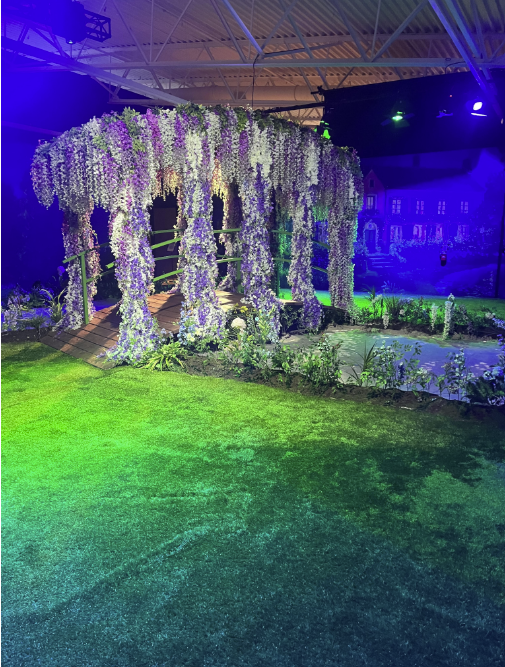
The third room does, however, live up to the “immersive” experience as viewers are given the opportunity to walk into a room that looks like Monet’s house with his paintings (Water Lilies, Impression, Sunrise and Poppies) plastered on the walls. Unfortunately, none of the paintings are real. The fourth room also allows three-dimensional passage into one of Monet’s paintings, as you are greeted with a pond and a bridge covered with flowers that was a replication of Monet’s painting Bridge Over a Pond of Water Lilies. The downside to this is that it is all light projections making this experience happen. This makes it not fully capture the environment, with the other factors of that it doesn’t cover the whole floor/ceiling, which can break the illusion.
The fifth room leads into a gigantic space with chairs and light projections covering the walls, while classical music plays in the background. It does create a relaxing environment, but if the viewers want to truly see or learn anything, viewers must stay a long time as the visuals move very slowly. After this, the viewers are led to the final place of the exhibit, the VR room. The VR room has chairs surrounding the room with the optional VR experience attached to each chair, in order to be fully immersed in Monet’s paintings. After going through the whole exhibit, it seems expensive for what is provided, as viewers pay at least $30 for one ticket.
Although some may say that it is stunning, others could agree that it is underwhelming and repetitive. If paying $30 for a projection-based experience is something that is of interest, then this exhibit is perfect for you. Otherwise, I would recommend skipping this exhibit and driving up to the National Gallery of Art in Washington, DC or waiting until the fall when the “Impressionist Revolution” exhibit is scheduled to open at the VMFA.